What Size Wall Art Should You Buy for a Large Wall? A 6–12 ft Wall Size Guide
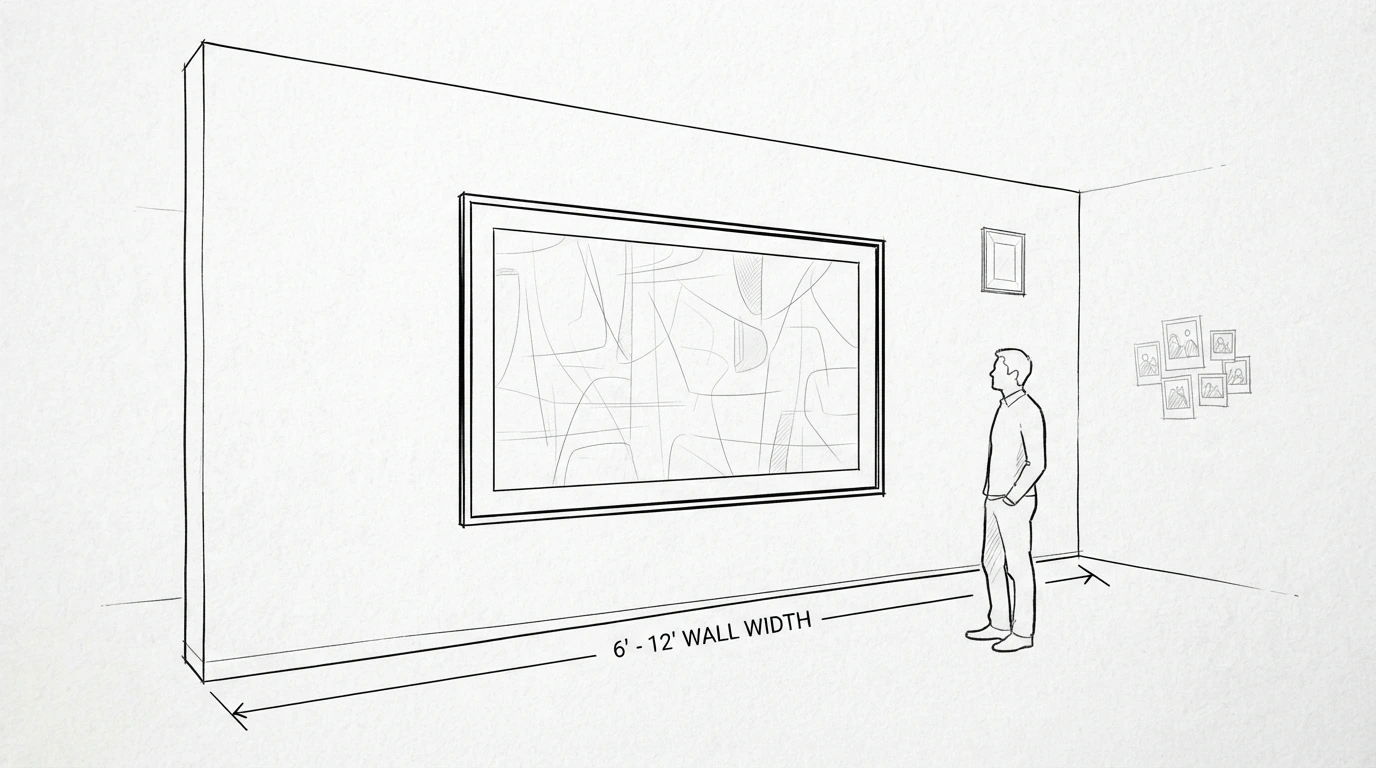
A 24×36-inch print looks substantial in a product photo. Hung on a 10-foot wall, it covers about 20% of the width, and the wall reads as unfinished.
Large walls fail in two ways. The art is too small, so it floats in space. Or it’s too big and crowds the furniture. Online listings make both easy: dimensions are just numbers, and the sofa, ceiling height, and window trim all change what “right” means.
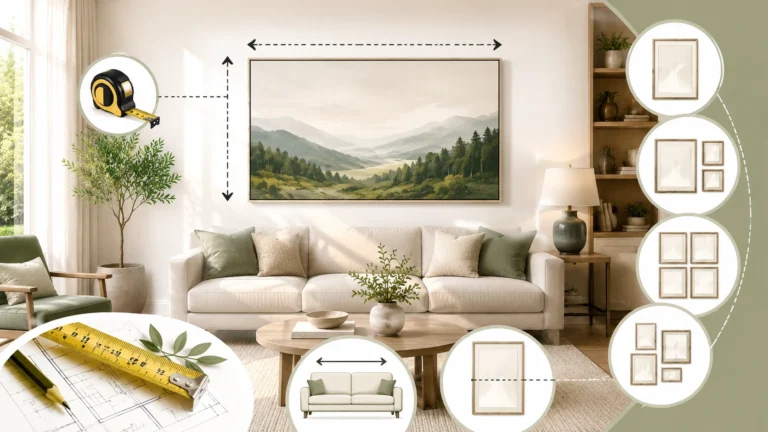
This guide replaces guessing with arithmetic. You’ll measure the wall, pick a reference width, calculate a target range, and test it with tape before you buy.
Quick Answer: Wall Art Size by Wall Width
Start with 60–75% of the reference width. The reference is the furniture under the art if there is any, or the wall width if the wall is bare. These are starting points, not laws. Furniture width, ceiling height, and room size can all shift them.
| Wall width | Target art width (60–75% of a bare wall) | Suggested approach | Typical orientation | Best use |
|---|---|---|---|---|
| 6 ft (72″) | 43–54″ | A diptych, or one medium-large piece | Vertical pair or horizontal | Loveseat wall, entry, bedroom |
| 8 ft (96″) | 58–72″ | One large piece or a triptych | Horizontal | Standard sofa wall |
| 10 ft (120″) | 72–90″ | Oversized piece or a wide grid | Horizontal or grid | Feature wall, open plan |
| 12 ft (144″) | 86–108″ | Large grid or grouped compositions | Grid, or tall if the ceiling allows | Great room, double-height wall |
If a sofa sits under the art, calculate from the sofa width instead. An 84″ sofa gives roughly 50–63″ of art.
How to Measure Your Wall Before Buying Art
- Measure the wall width, corner to corner, in inches.
- Measure usable height, floor to ceiling minus any crown molding or beams.
- Identify what’s underneath: a sofa, console, bed, or nothing.
- Measure the furniture’s full width, including arms.
- Note the ceiling height. Tall ceilings can carry taller art.
- Mark obstacles: windows, doors, vents, switches, sconces.
- Decide the wall’s role. Is it the room’s focal point or a supporting wall?
Write the numbers down. Every calculation below uses them.
The Basic Wall Art Size Rule (and Why It Works)
Most designers size art relative to the furniture beneath it, at roughly 60–75% of its width. Your eye reads the sofa and the art as one grouped shape. If the art is much narrower than the sofa, it looks like an afterthought. If it’s wider than the sofa, it can look like it’s overhanging.
A bare wall has no furniture to anchor the group, so the wall width becomes the reference. The same range applies.
A large wall with a smaller sofa creates a conflict. On a 12-foot wall with a 90″ sofa, the sofa suggests 54–68″ of art, but the wall suggests 86–108″. Don’t blindly take either number. Aim for the top of the furniture range, keep the group no wider than the sofa, and let the extra wall breathe, or balance it with a second group.
For a room-by-room version of this math, see our wall art size calculator.
What Size Wall Art Works on a 6-Foot Wall?
Target width: 43–54″.
- Single piece: about 44–54″ wide, such as a 48×36 landscape.
- Diptych: two 24×36 prints with a 2″ gap total about 50″ wide and 36″ tall.
- Horizontal vs vertical: two vertical panels suit a narrow wall beside a door. One horizontal piece suits a loveseat wall.
- Furniture effect: a 60″ loveseat suggests 36–45″ of art, so the furniture range may win. Two 20×30 prints total about 42″.
- Avoid: one 24″-wide print, which covers only a third of the wall.
What Size Wall Art Works on an 8-Foot Wall?
Target width: 58–72″. This is the standard sofa wall.
- Single large piece: about 60×40 landscape.
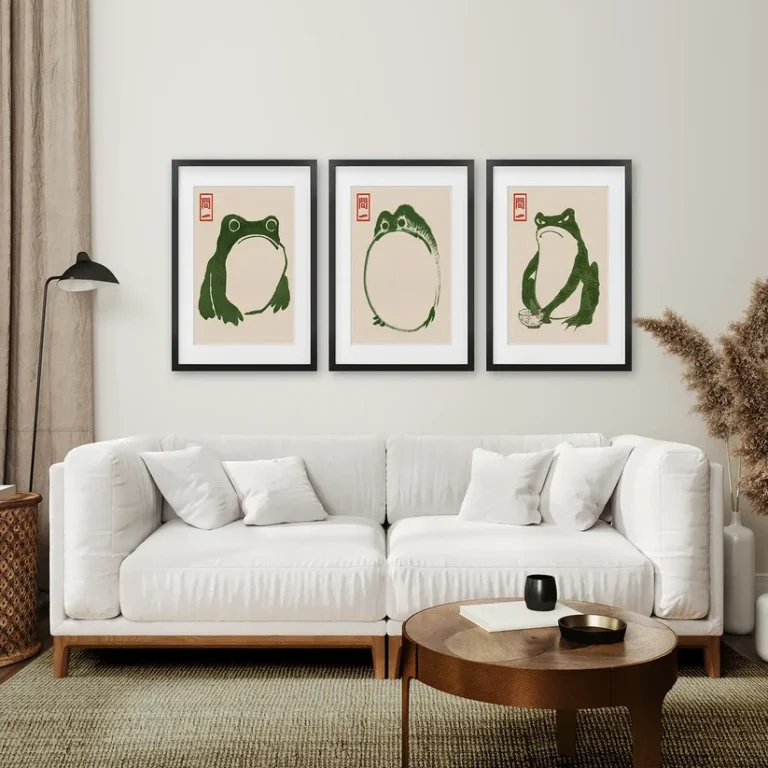
- Triptych: three 18×24 prints with 2″ gaps total 58″ wide. Three 20×30 prints total 64″.
- Above a sofa: an 84″ sofa suggests 50–63″, so 58–63″ satisfies both wall and furniture.
- Proportion check: three 24×36 portrait prints total about 76″, which suits only a sofa of 100″ or more.
- Wide, calm images help. A horizontal scene split across three panels reads as one wide composition.
What Size Wall Art Works on a 10-Foot Wall?
Target width: 72–90″. Medium art tends to look undersized here. A 36″ piece covers only 30% of the wall.
- Oversized single piece: 72×48 or similar, if you can source it.
- Grid: two rows of four 18×24 portrait prints with 2″ gaps total 78″ wide and 50″ tall. At 20×30 they total 86″ wide and 62″ tall.
- Check the stack height. A 50″ grid, a roughly 36″ sofa, and an 8″ gap add up to about 94″. That’s tight under an 8 ft (96″) ceiling, and the 62″ version won’t fit above a sofa.
- Furniture relationship: on a 10 ft wall with a 90″ sofa, use the top of the sofa range (54–68″) or keep the group near sofa width.
What Size Wall Art Works on a 12-Foot Wall?
Target width: 86–108″. No single standard print does this alone.
- Oversized single piece: the sizes I found top out at 24×36 per print, so this would need custom sizing.
- Large grid: four columns by three rows of 20×30 portrait prints total about 86″ wide and 94″ tall. At 24×36, it’s 102″ wide and 112″ tall, which suits staircases and double-height walls.
- Combinations: a central group plus a smaller group at one end can balance a wall the sofa doesn’t fill.
- Prevent emptiness: fill the wall in groups. Don’t spread small pieces evenly.
One Large Piece vs Multiple Pieces
One large artwork works when the wall needs a focal point, the room is minimalist, and the image itself is strong enough to carry the space.
Two pieces (diptych) suit a wall that’s slightly too wide for one piece, or when you want symmetry without a strong center.
Three pieces (triptych) are the workhorse for wide sofa walls. They cover width without needing one enormous print.
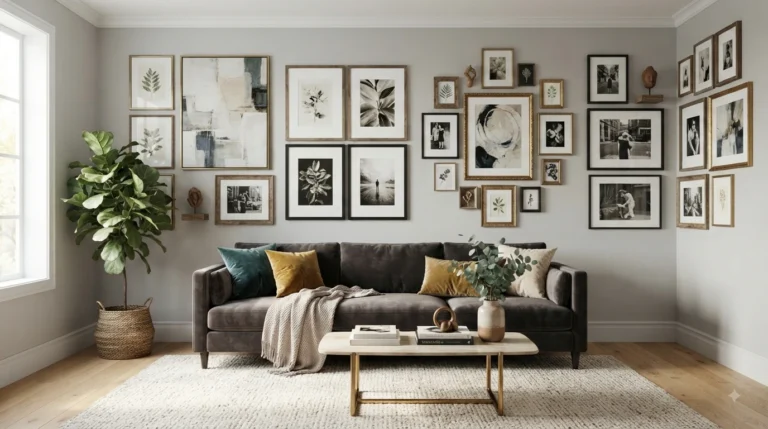
Multiple small pieces work when they’re grouped tightly and treated as one unit. Scattered across a large wall, they read as clutter.
For more ways to style a big wall, see our living-room wall art ideas.
Horizontal vs Vertical vs Square Wall Art
- Horizontal widens a wall and suits sofa walls and low ceilings.
- Vertical adds height and suits narrow walls, tall ceilings, and stairwells.
- Square is calm and stable. It works well in grids and on balanced walls.
Pick by asking what the wall lacks. A wide, low room wants a horizontal composition. A narrow, tall wall wants a vertical one.
Wall Art Above a Sofa
Art often looks too small above a sofa because buyers size it to the wall, not the sofa.
- Width: 60–75% of the sofa’s full width. For a 90″ sofa, that’s 54–68″.
- Balance: center the art on the sofa, not the wall.
- Hanging gap: start with the bottom edge about 6–10″ above the sofa back.
- One piece or several: one large piece for minimalism, a triptych or grid for a wider sofa.
- Why it looks small: the sofa is a big visual mass, so small art gets swallowed.
How High Should Wall Art Be Hung?
Two starting points apply:
- On a bare wall, place the center of the art around 57–60″ from the floor, roughly eye level.
- Above furniture, the furniture wins. Keep the bottom edge about 6–10″ above it so they read as one group.
Ceiling height matters. With 9–10 ft ceilings, you can go a little larger or hang slightly higher. With 8 ft ceilings, watch the total height of tall grids.
Don’t automatically center art on the wall. Center it on the furniture or on the visual zone you’re filling. For exact measurements, see our guide to how high to hang wall art above a sofa.
How to Visualize Art Size Before Buying
- Calculate your target width and height from the sections above.
- Tape the outline on the wall with painter’s tape.
- Or cut paper or cardboard to size and tape it up. Newspaper sheets taped together work for large sizes.
- For multi-panel sets, outline each panel and leave the real gaps between them.
- Step back to where you normally view the wall. Then sit down and look again.
- Adjust. Most people size up after seeing the rectangle in place.
How to Read Product Dimensions Online
- Width × height. Confirm which number is width. Most listings put width first, but check the size chart.
- Framed vs canvas. On wallartset.com, the listed size is per print, and for framed versions it’s the visible area inside the frame (including any mat). The frame adds to the outside. Its profile is listed as 0.625″ wide, so expect a little over an inch more in each direction.
- Canvas depth. Wrapped canvas is stretched on 1.5″ pine sub-frames, so it projects from the wall.
- Individual vs total (multi-panel). Listed sizes are per print. Total width = (number of panels × panel width) + (number of gaps × gap size). Three 24″ panels with 2″ gaps total 76″, not 24″.
- Spacing. A 2–3″ gap keeps a set reading as one composition.
Common Large-Wall Art Mistakes
- Buying too small. A 24″ print on a 10 ft wall is a 20% solution.
- Measuring only the wall. The furniture underneath sets the group.
- Ignoring ceiling height. Tall grids don’t fit above a sofa under an 8 ft ceiling.
- Reading one panel as the total. Multiply, then add gaps.
- Forgetting the gaps. They add several inches to a set.
- Choosing orientation by habit. Let the wall decide.
- Filling every inch. Leave breathing room.
- Buying on image alone. A beautiful image at the wrong size is still wrong.
- Ignoring frame and border size. Check whether the listed size is the visible area or the outside.
- Skipping the tape test. It takes ten minutes.
Product Picks by Wall Size
These are examples that illustrate specific sizing decisions. I haven’t tested them, and I’m not ranking them. The per-print size range of 8×10 to 24×36 was verified on two listings (Yosemite and Set of 12). Confirm sizes on each listing before ordering.
Matching Wall Art Set of 2 Builder — a diptych for a 6-ft wall
- Dimensions: per-print sizes not shown on the page I saw; check the builder.
- Orientation: chosen in the builder; not verified.
- Style: pick your own prints; framed, canvas, or unframed.
- Why it fits: a pair is an easy way to reach 43–54″ on a short wall.
- Sizing note: pair total = 2 × width + gap.
- Link: View the set of 2
Blue Waves, Sandy Beach. Minimalist 3 Piece Wall Decor — a triptych for an 8-ft wall
- Dimensions: per-print sizes; confirm on the listing.
- Orientation: not stated in the specs.
- Style: coastal wave and beach photography in soft blues and sand tones. Listing photos show it in thin wood frames.
- Why it fits: a calm, horizontal-feeling scene suits a standard sofa wall.
- Sizing note: three 18×24 prints total about 58″ wide.
- Link: View the triptych
Henri Matisse Abstract Painting Wall Art Prints — an abstract triptych above a sofa
- Dimensions: per-print sizes; confirm on the listing.
- Orientation: not stated in the specs.
- Style: abstract, colorful. Listing photos show black frames with a mat over a couch.
- Why it fits: a good example of art sized as a group above a sofa.
- Sizing note: for an 84″ sofa, aim for 50–63″ total.
- Link: View the set
Yosemite Valley Triptych — a landscape photo split into three panels
- Dimensions: each print available from 8×10 to 24×36 inches (per print).
- Orientation: not stated in the specs.
- Style: landscape photography; framed, canvas, or unframed.
- Why it fits: shows how one image can span three panels. For more landscape ideas, see our nature poster ideas.
- Sizing note: total width = 3 × width + gaps; the frame adds about an inch each way.
- Link: View the triptych
Gallery Wall Layout Builder, Set of 6 — a two-by-three grid
- Dimensions: not individually verified on this page.
- Layout: the listing image shows six frames in two rows of three.
- Why it fits: compact height with real width.
- Sizing note: at 18×24 portrait, about 58″ wide and 50″ tall.
- Link: View the builder
Big Wall Decor Builder, Set of 8 — a two-by-four grid for a 10-ft wall
- Layout: two rows of four frames, per the listing.
- Why it fits: the listing describes it as made for walls where ordinary wall art feels too small.
- Sizing note: at 18×24 portrait, about 78″ wide and 50″ tall. Check stack height.
- Link: View the builder
Large Gallery Wall Builder, Set of 12 — for 12-ft and double-height walls
- Dimensions: each print from 8×10 to 24×36 inches (per print).
- Layout: four columns by three rows, per the listing image.
- Why it fits: the listing mentions staircases, double-height spaces, and oversized feature walls.
- Sizing note: at 24×36, the grid is about 102″ wide and 112″ tall.
- Link: View the builder
Wall Art Set of 3 Builder — choose your own coordinated triptych
- Dimensions: confirm in the builder.
- Why it fits: lets you mix prints, frames, and sizes for a custom triptych.
- Link: View the builder
Custom sizes: the framed-print section says non-standard sizes are available on request, which is worth asking about for a true oversized piece.
Decision Guide
- Wall about 6 ft: consider a diptych or a 44–54″ piece.
- Wall about 8 ft: consider a 58–72″ piece or a triptych.
- Wall about 10 ft: consider an oversized piece or a grid, 72–90″ wide.
- Wall about 12 ft: consider a large grid or grouped compositions, 86–108″.
- Sofa underneath: use furniture width as an additional reference (60–75%).
- Very tall ceiling: consider vertical scale.
- Minimalist look: consider one stronger statement piece.
- Gallery-style look: consider multiple coordinated pieces.
Frequently Asked Questions
What is the best size wall art for a large wall?
Aim for roughly 60–75% of the reference width: the furniture below, or the wall if it’s bare.
How big should wall art be above a sofa?
About 60–75% of the sofa’s full width. For a 90″ sofa, that’s 54–68″.
Is oversized wall art too big for a living room?
Not if it stays within the range and you test it with tape.
What size art works on an 8-foot wall?
Roughly 58–72″ wide, as one piece or a group.
What size art works on a 10-foot wall?
Roughly 72–90″ wide. Medium-sized single pieces usually look small.
How do I choose wall art dimensions online?
Confirm width vs. height, whether the size is per panel, whether it includes the frame, and add gaps for sets.
Should large wall art be centered?
Center it on the furniture below when there is any; otherwise, on the zone you’re filling.
How high should large wall art be hung?
Start with the center at 57–60″ on a bare wall, or 6–10″ above furniture.
Final Checklist
□ Measure wall width
□ Measure furniture width
□ Check ceiling height
□ Decide one piece vs multiple
□ Check artwork dimensions carefully
□ Test dimensions with tape/paper
□ Consider orientation
□ Compare suitable wall-art options
Once your tape outline looks right, browse three-piece wall art sets →