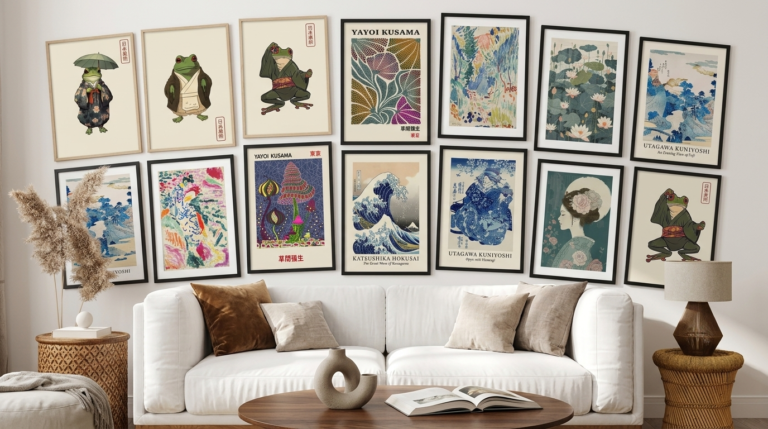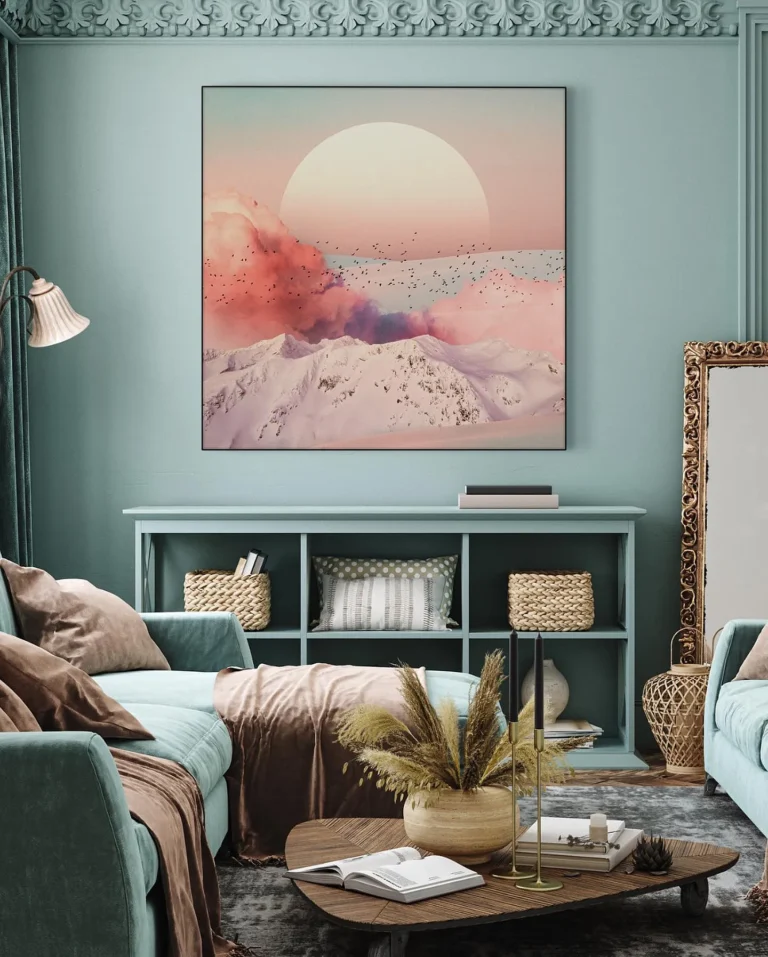
Oversized Wall Art: How Big Is Too Big? A Room-by-Room Sizing Guide
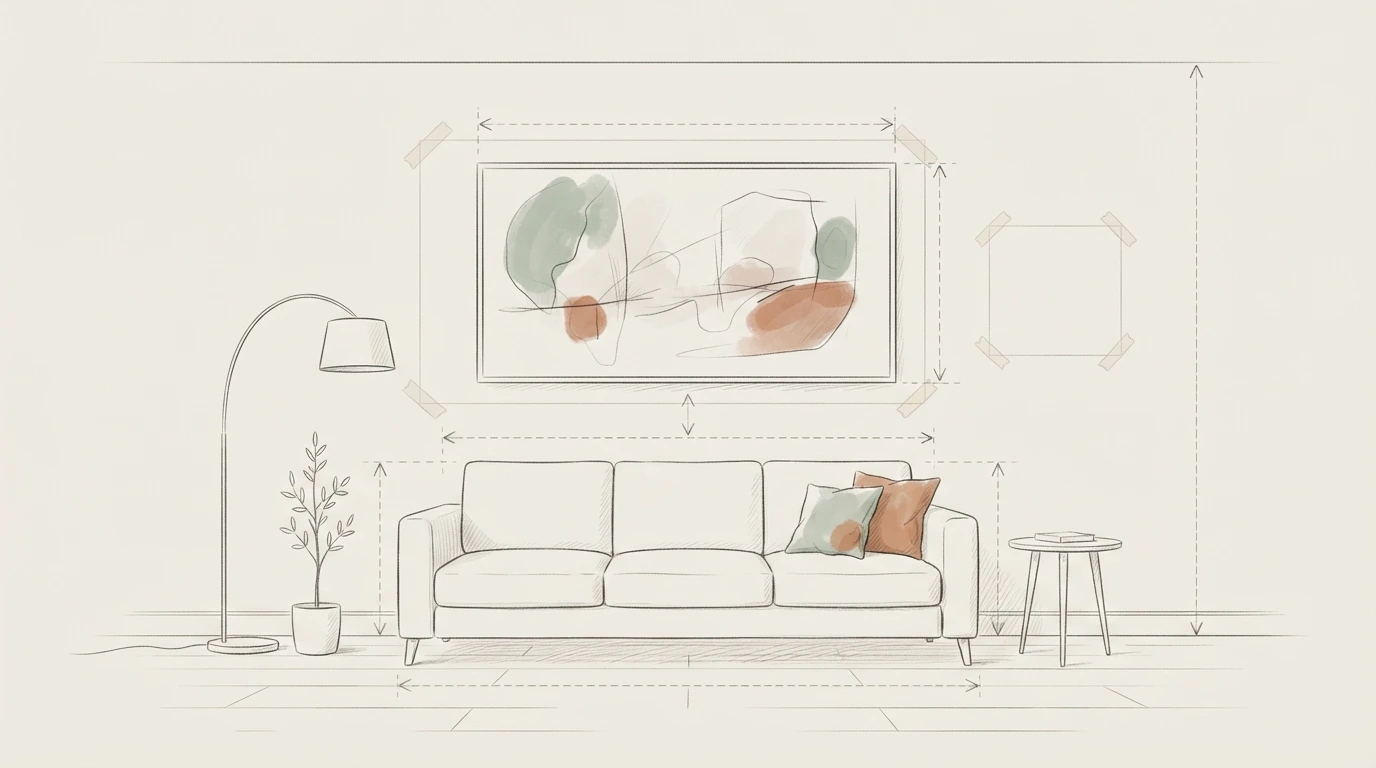
A large piece of art can do what ten small ones can’t. It gives the room one clear focal point, covers a blank wall, and makes the space look planned rather than accumulated.
The risk is that oversized art is easy to get wrong. A piece that’s a little too small looks timid. A piece that’s a little too big crowds the furniture, fights the windows, and makes the room feel smaller. So the real question is when oversized stops working and just becomes too large.
This guide answers that with measurements, a tape test, and room-by-room examples.
Quick Answer: How Big Is Oversized Wall Art?
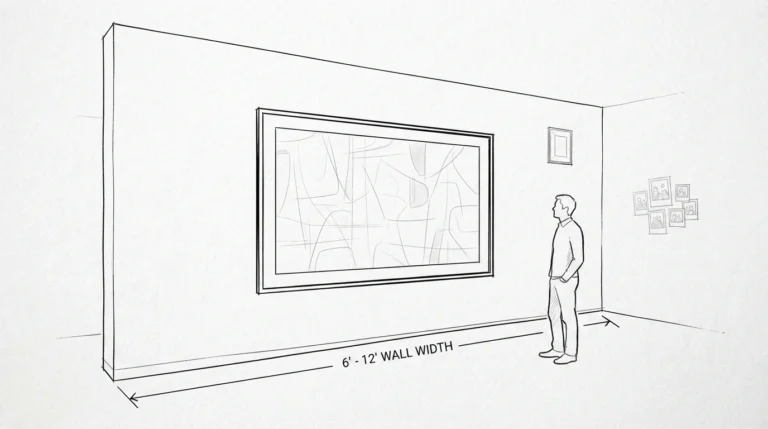
There’s no single size that counts as oversized. It depends on your wall, your furniture, your ceiling height and how far you’ll stand from the piece. A 60-inch-wide artwork is oversized above a 48-inch console and completely ordinary above a 110-inch sectional.
Three ideas hold up in most rooms:
- Furniture is your best reference. Art above a sofa, bed or table usually sits comfortably at roughly two-thirds to three-quarters of that furniture’s width. Oversized art pushes toward or slightly past the top of that range on purpose.
- Oversized should look intentional. It works when it has breathing room around it, and it fails when it looks squeezed in.
- The same piece behaves differently in different rooms. Test it in your room before you buy.
| Situation | Oversized Art Approach | Main Consideration |
|---|---|---|
| Large blank wall | One large piece or a wide multi-panel composition | Leave visible wall around the art so it doesn’t look wall-to-wall |
| Above sofa | Around 65–80% of sofa width, hung low | Sofa width matters more than wall width |
| Bedroom | One calm, large focal piece above the bed | Don’t let it visually outweigh the bed |
| Dining room | Wide horizontal or multi-panel piece centered on the table | Viewing distance and chair movement |
| Entryway | Tall vertical or modest-width piece | Narrow walls and traffic flow |
| Small room | One strong piece with plenty of space | Negative space |
These are starting points, not rules. Your tape test decides.
What Actually Counts as Oversized Wall Art?
Think of art size in four steps: small, medium, large, oversized. Where a piece lands depends on what’s around it.
- Wall-to-art proportion. On an empty wall, art covering roughly 60–75% of the usable width is a common target. Oversized pieces sit at the upper end or beyond it, but usually with visible wall left on both sides.
- Furniture-to-art proportion. Above furniture, the furniture usually wins. A common range is two-thirds to three-quarters of its width.
- Visual weight. A dense, dark, or busy image reads as bigger than a pale, quiet one of the same dimensions.
- Negative space. The empty wall around a piece is part of the composition.
- Room scale. Higher ceilings and larger rooms absorb bigger art.
For example, take a 60-inch-wide piece:
| Location | Reference width | Art as % of reference | How it reads |
|---|---|---|---|
| Above a 48″ console | 48″ | 125% | Too big, wider than the furniture |
| Above a 72″ sofa | 72″ | 83% | Oversized, at the upper edge |
| Above a 100″ sectional | 100″ | 60% | Normal |
These numbers are illustrative. They show the logic, not a universal definition.
The 3 Things That Determine Whether Art Is Too Big
1. Wall width
How much of the wall does the artwork occupy? Art that fills almost the entire wall leaves no margin, and the wall can feel like it’s shrinking. Leave visible wall on both sides.
2. Furniture width
This is often the more important check. The furniture underneath sets the visual base, and art wider than the furniture tends to look top-heavy. Measure the sofa, bed or table itself, not the wall behind it.
3. Ceiling height and room scale
- 8-foot ceilings: oversized here usually means wider rather than taller.
- 9–10 foot ceilings: you can go taller or larger overall without crowding the ceiling.
- Very high ceilings: vertical or stacked compositions carry the height better than one wide horizontal piece.
Also consider:
- Windows and doors. Art too close to a casing looks cramped.
- Wall breaks and fireplaces. Size to the usable section, not the full room.
- Viewing distance. Larger art needs more distance. In a narrow space, a huge piece can’t be seen properly.
How Much Empty Space Should You Leave?
Negative space is what makes oversized art look deliberate. As practical starting points:
- Side margins. Leave visible wall on both sides. Avoid sitting closer than roughly 8–12 inches to a window casing, door, or corner unless you’re doing it intentionally.
- Above furniture. A gap of about 6–10 inches between the top of the furniture and the bottom of the art keeps them connected.
- Below the ceiling. The art should not appear to touch the ceiling. Leave clear space.
- Near objects. Lamps, shelves and plants sitting close to the art make it look crowded.
A wall doesn’t need to be filled. A large piece with generous empty wall around it looks bigger and calmer than a huge piece jammed edge to edge.
Room-by-Room Guide
Living Room: How Big Is Too Big?
Sofa width is your main reference. For a typical 84-inch sofa, two-thirds to three-quarters is about 56–63 inches, and oversized might mean going to roughly 65–70 inches. Past about 80–85% of the sofa width, the art tends to dominate. For deeper guidance on proportions, see our guide to choosing wall art for a living room {{URL NEEDED}}.
Other living-room situations:
- Behind a sectional. Measure the section under the art, not the full L.
- Fireplace wall. Size to the mantel or the chimney breast, and keep it clear of the mantel objects.
- TV-adjacent wall. Keep art from competing with the screen. Simpler compositions work better.
- Open-plan spaces. Larger scale helps art hold its own in a big room.
Which format when?
- One oversized piece gives the strongest focal point and suits a clear, quiet wall.
- Two-piece composition suits a wall that’s wide but not very tall.
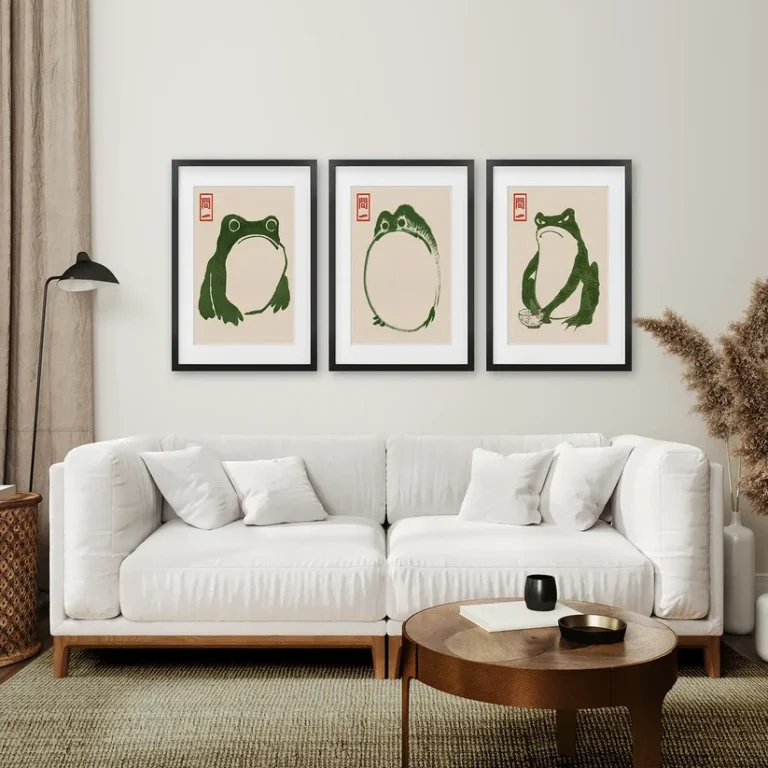
- Triptych or multi-panel suits a wide sofa or a wall you want to fill without one giant image.
Explore triptych options for the wall above your sofa →
(three prints, sizes from 8×10 up to 24×36 per print).
Bedroom: How Big Is Too Big?
The bed and headboard set the width. A standard queen mattress is about 60 inches wide and a king about 76 inches. Two-thirds to three-quarters of a queen is about 40–45 inches, and of a king about 50–57 inches. Oversized might push somewhat past that, but the art shouldn’t outweigh the bed.
- Calm beats busy. A dense or high-contrast piece over a bed can feel heavy.
- Wide vs tall. A horizontal piece echoes the bed. A tall vertical suits a feature wall beside it.
- One focal point. Oversized art works well here as the only statement in the room.
See a multi-piece option shown over a bed →
The product photos include white-framed prints over a bed. It’s a floral pattern set, so consider the visual density in a bedroom.
Dining Room: How Big Is Too Big?
Use the table width, not the wall. For a 72-inch table, two-thirds to three-quarters is about 48–54 inches. Horizontal or multi-panel pieces often suit the long line of a dining table.
- Furniture movement. Art hung too close to chairs or a sideboard gets bumped.
- Viewing distance. Diners view art from several feet away, so a larger, simpler image reads better than a detailed one.
- Sideboards. If there’s a sideboard under the art, size to the sideboard.
Explore large multi-panel wall-art options →
Check the product photos to see how the three prints sit together, since the page doesn’t state their orientation.
Entryway: How Big Is Too Big?
Entryways are usually narrow, so a piece that looks fine in a living room can overwhelm here.
- Narrow walls. Keep width modest and let height do the work.
- Tall ceilings. Vertical art or a stacked pair uses the height without crowding.
- Viewing distance. You often see the wall from a few feet away, so avoid huge detailed images.
- Obstruction. Make sure the art doesn’t stick out into a walkway or clash with a door swing.
Small Room: Can Oversized Artwork?
Sometimes yes. It can work when:
- There’s one strong piece.
- The surrounding decor is simple.
- The art leaves breathing room on the wall.
It fails when:
- The art covers almost the whole usable wall.
- Furniture, accessories, and art all compete.
- There’s no negative space left.
| Oversized done well | Too large |
|---|---|
| One piece, visible wall around it | Art nearly touches walls, ceiling and furniture |
| Calm image, simple surroundings | Dense image plus busy decor |
| Hung low, connected to furniture | Floating, dominating the room |
If your small-room wall is behind a desk, such as a gaming or home-office setup, our gaming-room wall art guide has size advice for that layout: gaming room wall art ideas.
Above-Sofa Oversized Art
Sofa width drives the decision:
- Width: roughly two-thirds to three-quarters of the sofa is standard; oversized goes toward the top of that range or a bit beyond.
- Height: hang so the center sits around 57–60 inches from the floor, with the bottom of the art about 6–10 inches above the sofa back. See our hanging-height guide
{{URL NEEDED}}. - Sectionals: size to the longest continuous section.
- Ceiling height: on 8-foot ceilings, keep the total height of art plus gap comfortable below the ceiling.
Worked example: a three-print set above a sofa. These numbers use unframed prints and an assumed 2-inch gap between prints. Framed versions run larger (see the dimensions section below).
| Size per print | Height | Total art width (3 prints + 2″ gaps) | As % of an 84″ sofa |
|---|---|---|---|
| 24×36 | 36″ | 76″ | about 90% |
| 20×30 | 30″ | 64″ | about 76% |
| 18×24 | 24″ | 58″ | about 69% |
| 16×20 | 20″ | 52″ | about 62% |
If the store lists a 24×36 size, that’s a real oversized composition, and on an 84-inch sofa it lands near 90%, likely too big for many rooms. The 20×30 option (about 76%) is an oversized-but-controlled choice. Take the 76-inch total straight to your tape test.
One Huge Piece vs Multiple Large Pieces
One large statement artwork
- Advantages: strongest focal point, simplest composition, easiest to style.
- Limitations: it needs confident sizing, and a wrong size is very visible.
Two-piece arrangement. Works when the wall is wide, and you want a bit of rhythm. Keep the gap consistent.
Triptych. Works on wide walls and above long furniture. One image split across three panels reads as a single wide composition.
Multi-panel sets. Check three numbers before buying:
- Individual panel size.
- Total composition width (panels plus gaps).
- Spacing. Wider gaps make the arrangement wider and looser.
Many buyers see “24×36” and assume the whole set is 24 inches wide. On Wall Art Set, the size shown is per print. A three-print set at 24×36 needs about 76 inches of wall.
The store’s largest listed size is 24×36 per print. It also says non-standard sizes can be requested through its contact page, so ask before assuming a bigger custom size is available. If you want a gallery-style wall instead, the store has set-of-6 and set-of-12 builders; check the size options on those pages before planning.
Explore large multi-panel wall-art options →
Horizontal vs Vertical Oversized Art
| Orientation | Often Useful For | Watch Out For |
|---|---|---|
| Horizontal | Above sofas, beds, dining tables | Can look too wide on a narrow wall |
| Vertical | Tall walls, entryways, beside windows | Can look stretched above wide furniture |
| Square | Balanced walls, feature areas | Can feel boxy above long furniture |
| Multi-panel | Wide walls, large furniture | Total width is easy to underestimate |
Let the wall shape lead. Wide, low wall: horizontal. Tall, narrow wall: vertical.
How to Tell If Your Wall Art Is Too Big
Ask these questions:
- Does it leave reasonable breathing room on the sides?
- Does it overpower the furniture beneath it?
- Does it collide visually with windows or doors?
- Does the room feel more crowded with it?
- Can you stand far enough back to see it comfortably?
- Does it dominate every other element in the room?
- Does the whole wall feel balanced?
- Does the orientation suit the wall?
If you answer “no” to questions 1, 5, or 7, or “yes” to 2, 3, 4, or 6, it’s probably too big. If everything passes and the piece still feels bold, it’s appropriately oversized.
The Tape Test
This is the most reliable way to check size before buying.
- Get the artwork dimensions, including frame and, for sets, all panels and gaps.
- Mark the outline on the wall with painter’s tape (or tape paper sheets together).
- Step back to the far side of the room.
- View from your normal seat on the sofa or bed.
- Check side margins.
- Check the relationship to the furniture.
- Check nearby windows, doors, and switches.
- Adjust the outline larger or smaller until it feels right, then buy to match.
How to Read Oversized Art Dimensions Online
- Width × height. Usually width first, but confirm.
- Framed vs unframed. On Wall Art Set, the framed size refers to the visible area inside the frame, including mat if used. The listed frame is 0.625 inches wide, so the outside edge runs somewhat larger. Check the store’s size table.
- Canvas depth. The store lists wrapped canvas on 1.5-inch stretcher bars.
- Panel vs total. Sets list the size per print. Multiply by the number of panels and add gaps.
- Spacing. Add your intended gaps.
- Orientation. Not always stated. Check the product photos.
- Product photos. Styled room photos can make art look bigger or smaller. Trust the numbers.
Common Oversized Wall Art Mistakes
- Confusing “large” with “appropriate.” Test it against the room.
- Measuring the wall but ignoring the furniture. Measure both.
- Ignoring negative space. Leave visible wall around it.
- Buying because the product photo looks impressive. Check the dimensions.
- Forgetting multi-panel total width. Add panels and gaps.
- Ignoring ceiling height. Check height as well as width.
- Putting a wide horizontal piece on a very tall wall without thinking about composition.
- Using several large pieces where one would balance better.
- Hanging too high. Keep it connected to the furniture.
- Buying before testing. Tape first.
Oversized Wall Art by Room: Quick Reference
| Room | What Usually Matters Most | Suitable Approach | Common Mistake |
|---|---|---|---|
| Living room | Sofa/wall proportion | Wide piece or triptych | Sizing to the wall only |
| Bedroom | Bed/wall proportion | Calm, single focal composition | Heavy image over the bed |
| Dining room | Table/wall proportion | Wide horizontal or multi-panel | Ignoring chair movement |
| Entryway | Wall width + viewing distance | Vertical or modest width | Going too wide |
| Small room | Negative space | One piece with breathing room | Filling the wall |
Product Picks by Use Case
Everything below is from the Wall Art Set. I checked the product pages for the details listed, and I haven’t tested these products myself. Prices, discounts, and stock change, so check the product pages.
For Above a Sofa or a Wide Wall
Yosemite Valley Triptych. US National Park Wall Art Prints
- Verified dimensions: size options from 8×10 up to 24×36 inches per print; the price shown is for the full set.
- Orientation: not stated on the page. Check the product photos.
- Format: three prints; unframed, black, white, or wood frames (with or without mat), or wrapped canvas.
- Style: national-park landscape photography; the description says one mountain-lake photograph is divided into 3 pieces.
- Best suited for: above a sofa or on a wide wall.
- Why it fits: one image spread across three panels reads as a single wide composition.
- Sizing note: add panels and gaps. A three-print set at 24×36 needs about 76 inches of wall.
For a Bedroom Feature Wall
William Morris 3 Piece Wall Art Set
- Verified dimensions: the same 8×10 to 24×36 inch options per print; price is for the full set.
- Orientation: not stated; the product photos include white-framed prints over a bed.
- Format: three prints; unframed, black, white, or thin-wood frames (with or without mat), or wrapped canvas.
- Style: William Morris floral pattern.
- Best suited for: a bedroom feature wall over the bed.
- Why it fits: shows how a three-panel set works above a bed.
- Sizing note: pattern art is visually denser, so test it with tape.
- Link: William Morris 3 Piece Wall Art Set
For Mixing Your Own Set
Set of 3 Builder (mix and match)
- Note: I did not check this page’s size options, so confirm them before planning.
- Link: Set of 3 builder
Quick Decision Guide
- Wall wide and low: consider a wide horizontal piece or a horizontal multi-panel arrangement.
- Wall tall: consider vertical artwork or a vertically stacked composition.
- Wide sofa: compare the total art width to the sofa width.
- Small room: prioritize one strong piece with plenty of empty wall.
- Very large wall: consider one large piece or a coordinated multi-panel composition.
- Unsure: do the tape test.
FAQs
How big is oversized wall art?
There’s no fixed size. It’s art noticeably larger than the usual 60–75% range for the wall or furniture it’s on.
How big should wall art be above a sofa?
A common starting point is two-thirds to three-quarters of the sofa’s width. Oversized goes toward the top of that range.
Is oversized wall art too big for a small room?
Not necessarily. One piece with plenty of empty wall can work. Art that fills almost the whole wall usually doesn’t.
Is one large piece better than several smaller ones?
One piece gives a simpler focal point. A triptych or multi-panel set can fill a wide wall without needing one giant image.
What size wall art works in a bedroom?
Aim for about two-thirds to three-quarters of the bed’s width, and keep the image calm.
How do I know if art is too big?
Tape the outline on the wall and check the margins, the furniture relationship, and the viewing distance.
Final Checklist
□ Measure the wall
□ Measure the furniture
□ Consider ceiling height
□ Check negative space
□ Decide one piece vs multiple pieces
□ Check the actual artwork dimensions
□ Check total dimensions of multi-panel art
□ Use painter’s tape to test the size
□ Compare suitable wall-art options
When your tape outline feels right, you can compare triptych and multi-panel wall-art sets at sizes that match it.