
Canvas vs Framed Print vs Acrylic: Which Wall Art Should You Buy?
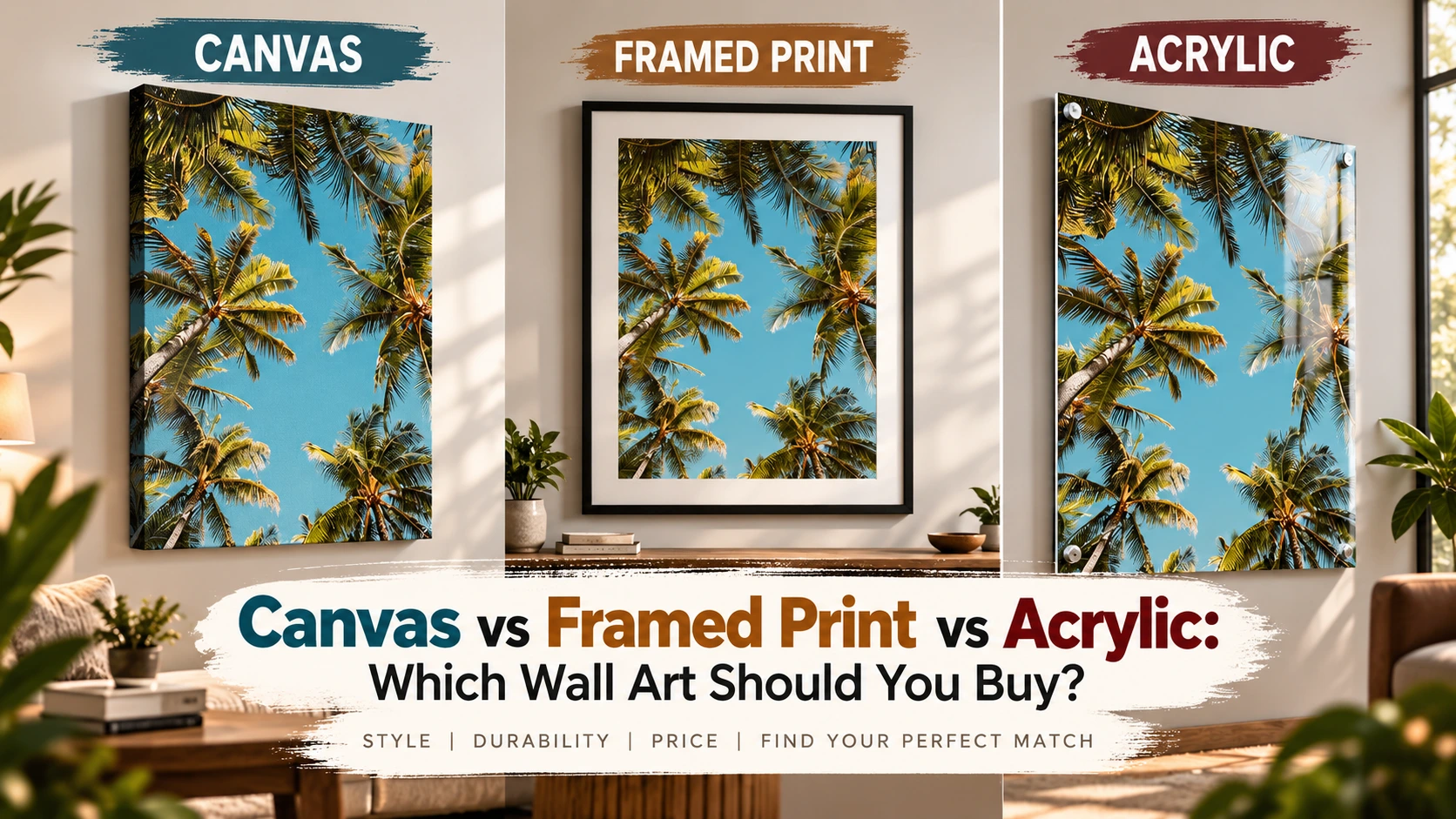
I’ve bought all three. A canvas print that’s been on my living room wall for two years, a framed print in the hallway that gets swapped every few months, and an acrylic piece in a brighter room that gets direct afternoon light. Each one taught me something the product page didn’t.
If you’re standing at a checkout page right now trying to pick between “Canvas,” “ArtFab” (framed print), and “Acrylic” — and genuinely don’t know what the difference between canvas vs framed print vs acrylic means for your wall — this guide is for that exact moment.
The Quick Answer
- Pick Canvas if you want a warm, textured, classic look and don’t want to think about it again for years
- Pick a Framed Print (ArtFab) if you like to change up your décor seasonally or move often
- Pick Acrylic if the room gets good light and you want that glossy, gallery-wall effect
Now here’s why, in more detail.
Canvas vs Framed Print vs Acrylic: At a Glance
| Factor | Canvas | Framed Print (ArtFab) | Acrylic |
|---|---|---|---|
| Look & finish | Soft, matte, textured | Clean, structured, fabric-based | Glossy, high-depth, reflective |
| Best lighting | Any lighting, low glare | Any lighting | Bright rooms, avoid direct glare spots |
| Durability | Very durable, minor dust over time | Frame lasts years, print swappable | Scratch-prone surface, needs careful cleaning |
| Weight | Light to medium | Light | Heavier, especially in large sizes |
| Ease of swapping art | Hard — it’s one fixed piece | Easy — just swap the print inside the frame | Hard — one fixed piece |
| Feels like | A traditional painting | A modern gallery frame | A high-end photo print |
| Best for | Living rooms, bedrooms, classic spaces | Renters, frequent redecorators | Offices, modern spaces, bold colors |
Canvas: The One That Never Goes Out of Style
Canvas is the material most people picture when they think “wall art.” It’s fabric stretched over a wood frame, and BIG Wall Décor’s version comes wrapped with the image continuing around the edges, so there’s no visible border interrupting the piece.
What I like about it:
- The texture actually softens the room — it doesn’t look like a printed poster
- Low-glare, so it works well no matter where your lights or windows are positioned
- Feels substantial without being heavy to hang
Where it falls short:
- Canvas can sag slightly over many years in humid climates
- Colors are slightly less vivid than acrylic — it’s a warmer, softer rendering, not a punchy one
- Once it’s up, it’s up. You’re not swapping the print out easily
BIG Wall Décor also offers a Stickablez option — peel-and-stick canvas — which is worth knowing about if you’re renting and can’t put holes in the wall.
Framed Print (ArtFab): The One Built for Change
This is the option most people skip past without realizing what it actually does differently. ArtFab is a fabric print paired with a slim aluminum frame — but the real feature is that the print and frame are separate. You can order new prints later and swap them into the same frame.
What I like about it:
- If you redecorate often, you buy the frame once and only pay for prints after that
- The aluminum frame options (black, silver, or backlit) give it a more “designed” look than raw canvas
- Lighter than canvas or acrylic, so hanging is easier — useful for larger sizes
Where it falls short:
- It reads a little more “modern gallery,” which won’t suit every style of room
- The frame itself is a visible design element — if you want the art to be the only focus, this adds a border around it
This is genuinely the best pick if you’re someone who gets bored of the same piece after a year. You’re not rebuying the whole setup, just the print.
Acrylic: The One That Makes Colors Pop
Acrylic wall art is the print mounted behind a sheet of acrylic glass. It’s the option that consistently gets the “wait, what is that made of?” reaction from people who see it in person.
What I like about it:
- Colors look genuinely richer — there’s a depth to it that neither canvas nor framed prints replicate
- The gloss finish gives it a premium, gallery feel straight out of the box
- Available in gloss or matte, so you can dial down the reflection if your room has strong overhead lighting
Where it falls short:
- It shows fingerprints and dust more than canvas or framed prints
- Glare is a real issue if it’s directly across from a window or bright lamp — worth checking your room’s light direction before buying
- It’s heavier, so double-check your wall anchors for larger sizes
Acrylic tends to work best in rooms that don’t get harsh direct light hitting the piece head-on — think hallways, offices, or living rooms with softer, indirect lighting.
Which One Should You Actually Buy?
Here’s how I’d think about it based on your situation, not just the material specs:
- Renting or moving often? → Framed Print (ArtFab) or Stickablez Canvas — both avoid permanent wall damage or let you take the frame with you
- Want the room to feel warm and traditional? → Canvas
- Room has bold, saturated colors in the artwork? → Acrylic will make that color choice hit harder
- Buying for above a sofa or a large focal wall? → Canvas or Framed Print — both are lighter and easier to hang at large sizes than acrylic
- Buying for a home office or a room with track lighting? → Be cautious with Acrylic unless you can control glare; Canvas is the safer pick
A Few Things Nobody Tells You Before You Buy
- Pricing varies by finish, not just size. The same artwork can cost differently depending on whether you pick Canvas, ArtFab, or Acrylic — always check the price after selecting your material and size, not before
- Shipping fragility is real for acrylic. It’s more likely to need careful unboxing — not a dealbreaker, just something to expect
- Framed prints are the easiest to level and re-hang if you’re not confident with a drill and a level — the aluminum frame comes with straightforward hardware
Frequently Asked Questions
Is canvas or acrylic better for wall art?
Neither is objectively “better” — canvas gives a softer, warmer look with almost no glare, while acrylic gives richer color and a glossier, more premium finish. The right choice depends on your room’s lighting and your personal style.
Which is cheaper: canvas, framed print, or acrylic?
Pricing depends on the specific size and finish you select, so it’s worth comparing directly on the product page for the exact piece you want rather than assuming one material is always cheaper.
Can I swap out a framed print later?
Yes — that’s the main advantage of a framed print like ArtFab. The frame stays on your wall, and you only need to order a new print to change the look.
Does acrylic wall art scratch easily?
It can show fingerprints and light scratches more than canvas, so it’s worth wiping it down with a soft, dry cloth rather than anything abrasive.
The Bottom Line
If you want a simple rule: Canvas for warmth, Framed Print for flexibility, Acrylic for impact. None of these are wrong choices — they just solve different problems depending on your room, your lighting, and how often you like to change things up.
Not sure what size to get once you’ve picked a material? Run your wall measurements through our Wall Art Size Calculator before you order.
Affiliate Disclosure: This article contains affiliate links to products sold on BIG Wall Décor. If you purchase through these links, this site may earn a commission at no extra cost to you.







One Comment